

Sony A7r Iii Vs A7 Iii
Disclosure: As an Amazon Associate I earn from qualifying purchases fabricated through links on this site. I may too earn from links to other online retailers at no actress cost to yous.
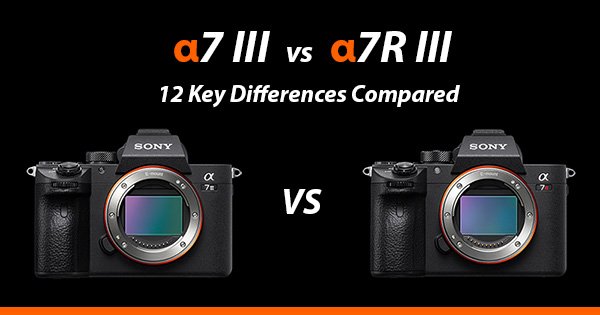
The Sony a7 III (ILCE-7M3) and the a7R III (ILCE-7RM3) share many features in mutual, but they besides have their ain unique features that distinguish these cameras apart from one some other.
In this comparison article I'1000 going to accept a closer await at the 12 primal differences between the Sony a7 Three and the a7R 3. At the launch event Sony chosen the a7 3 their "basic" full frame model, but information technology's definitely anything just basic.
The Sony a7R Three is without a doubt an first-class camera, simply is it really worth $1200 more the a7 III? This article volition try to reply that question.
Related comparison manufactures: a7 3 vs a9 | a7 2 vs a7 III
i. Image Sensor and Processor
Although both cameras share a similar back-illuminated Exmor R CMOS sensor, the difference here is that the sensor in the a7 III has a resolution of 24.two megapixels, whereas the a7R III has a massive 42.4 megapixels.
Both sensors are using the latest BIONZ X prototype processing engine and front-end LSI, which helps to improve readout speeds and data processing adequacy.
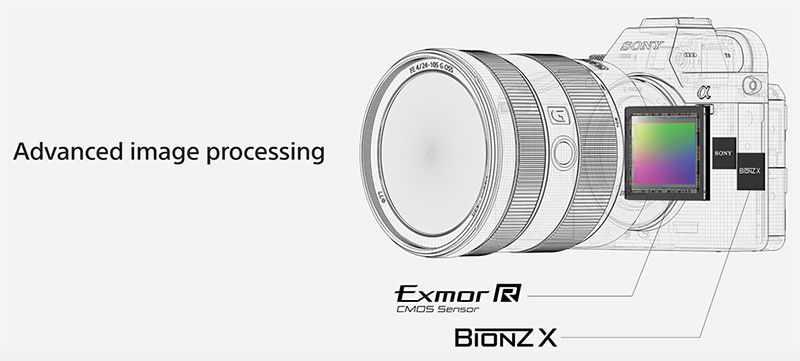
Possibly one of the nearly of import differences between the sensor in the a7 III and a7R Three, is that the a7R III does non include an optical low-laissez passer filter (anti-aliasing filter) in front of the sensor, whereas the a7 III does include an anti-aliasing filter.
Just in instance yous didn't know, an anti-aliasing filter helps to reduce distortion, but in doing so it too makes images slightly less abrupt. The a7R III however has been designed and so that it does non require an anti-aliasing filter, this allows for sharper images with a college resolution.
Both cameras include in torso epitome stabilization that works accross five-axis, but the A7r III is rated at five.5 stops, this compares with 5 stops for the a7 Iii.
2. Dynamic Range and ISO Functioning
The ISO sensitivity range is slightly unlike betwixt the two cameras. The a7 Iii has a 100-51200 native ISO range and an expanded range of 50-204800. The a7R III has a native ISO of 100-32000 and 50-102400 expanded. Both cameras tin record uncompressed and compressed 14-bit RAW.
According to DPReview, the a7 3 more or less matches the base ISO dynamic range of the a7R III (14.6 EV for the a7 III and 14.eight EV for the a7R III). This means both cameras will give yous similar ability to make use of (burnish) shadows in Raw files if y'all want to testify a wider dynamic range than shown with the default tone curve.
iii. The Photographic camera Torso
The a7 Iii inherited a very like body (simply non identical) to the a7R III. So you will exist pleased to know that the a7 3 as well includes the aforementioned touch screen, AF joystick, the dedicated AF-On push, dual SD Bill of fare slots (ane of which is UHS-II), a Protect/Charge per unit push button, relocation of the movie record push to near the viewfinder, and the new and much larger NP-FZ100 bombardment.
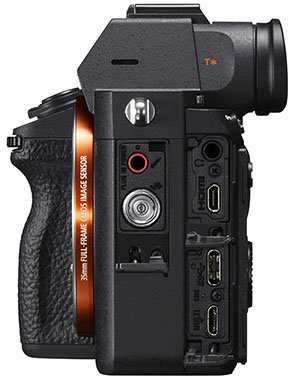
However, they are not completely identical. The a7R III features magnesium alloy for the front end, side, and rear covers, whereas the a7 III is missing the magnesium alloy on the rear. The a7 Three is also missing the lock button on the mode dial which the a7R Three does include. The a7R III also has an extra port for studio flash units and other external lighting equipment, this port is missing on the a7 III.
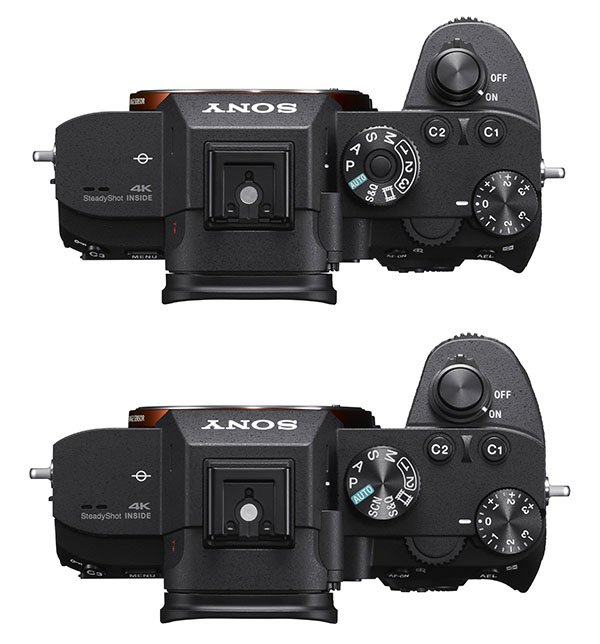
The a7 3 weighs in at approximately 650g or one lb 7.0 oz (with bombardment and SD Bill of fare), making information technology 7 grams lighter than the a7R III.
Both the a7 3 and a7R III bodies are dust and moisture resistant, so they should both withstand a short rain shower, but they are most definitely not waterproof. The weak betoken seems to be the base of operations of the camera, so y'all'll desire to avert setting your camera downwardly in any puddles if you are inclined to do such a daft thing 🙂
4. Autofocus System
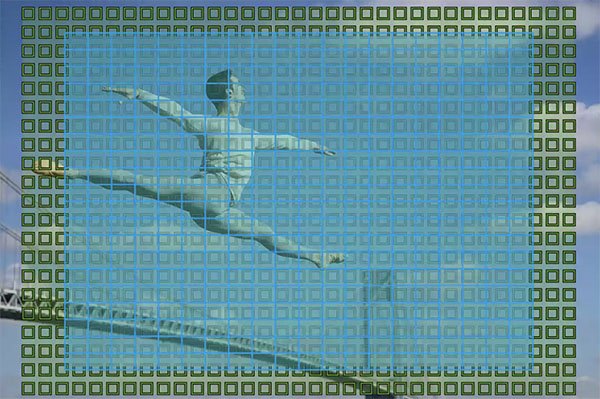
The autofocus system in the a7 Iii is derived from the 1 in the Sony a9. Therefore the a7 III features 693 phase-detection AF points that comprehend approximately 93% of image area (same as in the a9).
The a7R Iii actually has a smaller number of stage detection AF point (399), and these only cover 68% of the sensor area. The number of contrast detection AF points remains the aforementioned between both cameras at 425.
The following images provide an case comparison of the AF areas betwixt the two cameras. The dark-green squares bear witness the stage detection points and sensor coverage, whereas the blue squares show the contrast detection points and coverage area.
Sony a7 III
Sony a7R Three
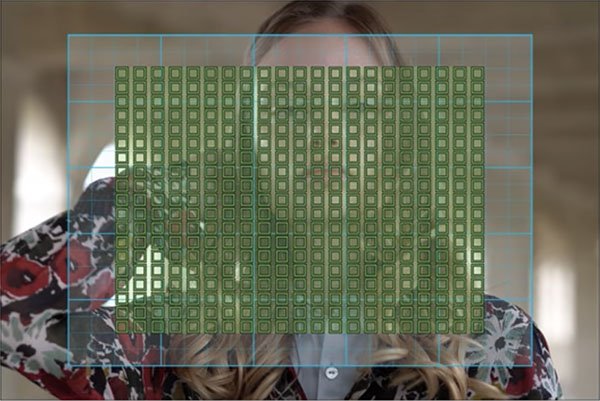
As is clear to see, the Sony a7 Mark Iii definitely has an advantage over the a7R Mark Iii hither when using phase find AF. This can be beneficial when tracking fast moving subjects across the frame like football players, superbikes, or birds in flight.
Both the a7 Three and the a7R Three characteristic middle autofocus (eye AF), and this too works in continuous shooting mode. Tracking sensitivity tin likewise be inverse, helping you to either maintain focus on your subject area, or provide the AF tracking with more freedom to spring to other subjects in the frame.
With the a7R III, when the aperture is greater than F8 in continuous shooting mode, the focus is locked to the setting in the showtime shot. With the a7 3, yous can shoot up to and including F11 before the focus is locked to the settings in the kickoff shot. This actually gives the a7 III the edge when shooting at higher apertures in continuous mode.
5. Shutter, Continuous Shooting, & Buffer
The a7 III now also has an electronic/silent shutter but like the a7R 3. Both cameras can shoot 10 frames per 2d with either the electronic or mechanical shutter, but if you want live-view then yous are limited to 8 fps.
The buffer on the a7 Mark III supports upward to approximately 177 JPEG images, 89 compressed RAW images, or forty uncompressed RAW images in ane continuous burst. This compares with 76 JPEG, 76 compressed RAW, or 28 uncompressed RAW images when shooting continuous on the a7R Marker Three.
Information technology'southward non actually surprising that the buffer supports less images on the a7R Iii, this is largely because the file sizes are almost double that of the a7 III due to the larger 42.4 megapixel sensor.
6. Video Specifications
Both the a7III and the a7RIII tin can record 4K video at up to 30fps and 100Mbps using XAVC Due south compression. However, there are a couple of important differences between the two cameras when information technology comes to video.
The a7 Iii supports 24p/25p 4K video recording with zero sensor crop, which is achieved by capturing 6K and then down sampling to 4k. At 30p recording is captured at roughly 5k, so there is a slight crop of 1.2x.
You can record video in 4k and total frame with the a7R Iii, but there is more noise visible at loftier ISOs due to the higher resolution of the sensor, shooting in APS-C/Super 35 mode will aid to improve the quality.
Both cameras support in-camera moving picture profiles, Due south-Log2, Southward-Log3 and a HLG (Hybrid Log-Gamma) profile for output to HDR Telly's without the demand for colour grading. They also both support Slow and Quick Motion (S&Q). This allows you to select between 1fps and 120fps for boring or fast motion clips.
Here's a video from Sony to demonstrate the 4K HDR (HLG) capabilities of the a7 Three:
And here's another video from Sony, but this time to demonstrate the 4K capabilities of the a7R III:
7. Viewfinder / LCD Screen
The Sony a7 Three has a 2.36 million dot OLED electronic viewfinder with a refresh rate of 60fps (just like its predecessor the a7 Ii), this results in a 1024 10 768 image. The a7R Three trumps this by having a 3.69 1000000 dot OLED viewfinder which also has a faster refresh charge per unit of 100/120fps.
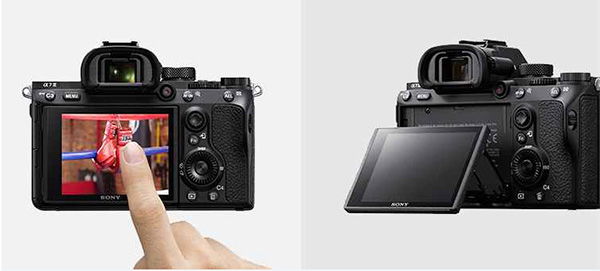
The rear LCD screens of both cameras feature touch on controls for selecting and moving your focus point and zooming in. You can also tilt the screen upwards and downward. Nevertheless the a7R III trumps the a7III by having a higher resolution LCD screen (one,440k vs 921k dots).
The higher resolution of both the viewfinder and LCD screen of the a7R Marker III is very beneficial when using focus magnification or the clear image zoom (digital zoom) part.
viii. Pixel Shift Multi Shooting
One feature that the a7R III includes that the a7 III does non is the Pixel Shift Multi Shooting manner. This function basically increases the resolution of your images by 4 times. The photographic camera takes four photos and shifts the sensor 1 pixel in between. You and so combine these images using Sony's Imaging Edge Software Suite (the camera itself doesn't do this) and y'all end up with an image that has 4 times the resolution of a normal raw epitome (4 10 42 megapixel).
The files that yous end up with are yet 42 megapixels in size, but they contain a lot more detail, especially noticeable when y'all zoom in 100%. I'd recommend watching the following video from Sony on exactly how this works:
The main advantage of Pixel Shift is increased color accurateness and sharpness, merely just if your subject area is perfectly nonetheless and your camera is on a very solid tripod, as the slightest movement will render the images useless.
Product photography, architecture photography, and nonetheless macro photography are areas where Pixel Shift volition really shine. Landscapes photography not and then much since at that place are most likely to exist moving elements like clouds, flowing water, or the air current blowing things around etc.
nine. Bombardment Life and Charger
Both cameras at present use the much larger NP-FZ100 battery which replaces the NP-FW50. The NP-FW50 was rated at a capacity of 1020mAh, whilst the new NP-FZ100 bombardment is rated at 2280mAh. This provides over double the capacity of the erstwhile battery.
Official Sony figures are 710 shots (with LCD screen) for the a7 Three vs 650 shots of the a7R III. Although it's important to note that in real life atmospheric condition you may actually shoot many more shots on a single accuse. I've shot well over 1000 images with my a7R Iii before I've needed to change the bombardment. Cold weather condition will too reduce battery life a lot faster.
Both cameras can be charged via USB, and the a7R Three also includes the Sony BC-QZ1 Battery Charger. Unfortunately the Sony a7 Iii does non include the charger, leaving yous with the but option of charging via USB. To charge the NP-FZ100 battery via USB takes approximately 5 hours, compared with two.v hours when using the BC-QZ1 Charger.
ten. Flash Sync Port
Both cameras have identical ports, however the a7R 3 also has an actress flash sync port for studio wink units and other external lighting equipment.
11. APS-C / Super 35 Mode
Both cameras feature an APS-C / Super 35 Way. This allows you to shoot with total frame lenses with a crop gene of 1.5x, or attach an APS-C lens. If y'all were to attach an APS-C lens without using APS-C mode, you lot volition notice black bars on either side of your image, this is because an APS-C lens volition not completely cover the full-frame 35mm sensor.
Although both cameras feature this option, when yous enable it on the Sony a7 Three your maximum image size will be x megapixels (3936 × 2624). However considering of the larger 42 megapixel sensor in the a7R Three, when you enable APS-C mode on this camera the maximum image size will be 18 megapixels (5168 × 3448).
Personally unless I was using an APS-C lens I would cull to crop in post rather than apply APS-C way on either photographic camera.
12. Price
The differences between the two cameras may non exist huge, but the price certainly is. Currently the a7 III costs $i,998.00 (United states of america Dollars) or £1999.99 for the trunk only, and the a7R 3 costs $3,198.00 (US Dollars) or £3199.00. So is the a7R III actually worth $1200 dollars more than the a7 III? I think this really comes downward to how much you need/desire that 42-megapixel sensor.
Conclusion
Despite the 12 key differences outlined hither, the real big difference is definitely the resolution of the sensors between these two great cameras. Although the Sony a7 III doesn't offer the 42-megapixel resolution of the a7R III, not every lensman wants or needs 42.iv-megapixels. Fifty-fifty for landscapes 24.ii megapixels is more plenty for most people.
If you are looking for a dandy all-round camera and don't require 42.four megapixels, and then I'd certainly recommend going with the a7 III. Likewise if y'all shoot a lot of sports and activity, and then the faster autofocus organisation, larger buffer, and increased number of phase detection points volition serve yous much better than the higher resolution of the a7R Three.
But if you love pixel peeping and actually must have the sharpest possible images for your landscape piece of work, compages, or portraits shots, then y'all probably already know that the a7R Three is going to be the best camera for your needs.
Already made your decision? Then it would be great to hear which camera you decided to go for and why in the comments below.
And if you take decided on the a7 III, then you might detect my Sony a7 III Accessories Guide useful. It can also exist used with the a7R III due to them sharing a similar body design.
Source: https://www.alphashooters.com/compare/sony-a7iii-vs-a7riii/
Posted by: parmercombou1979.blogspot.com
0 Response to "Sony A7r Iii Vs A7 Iii"
Post a Comment